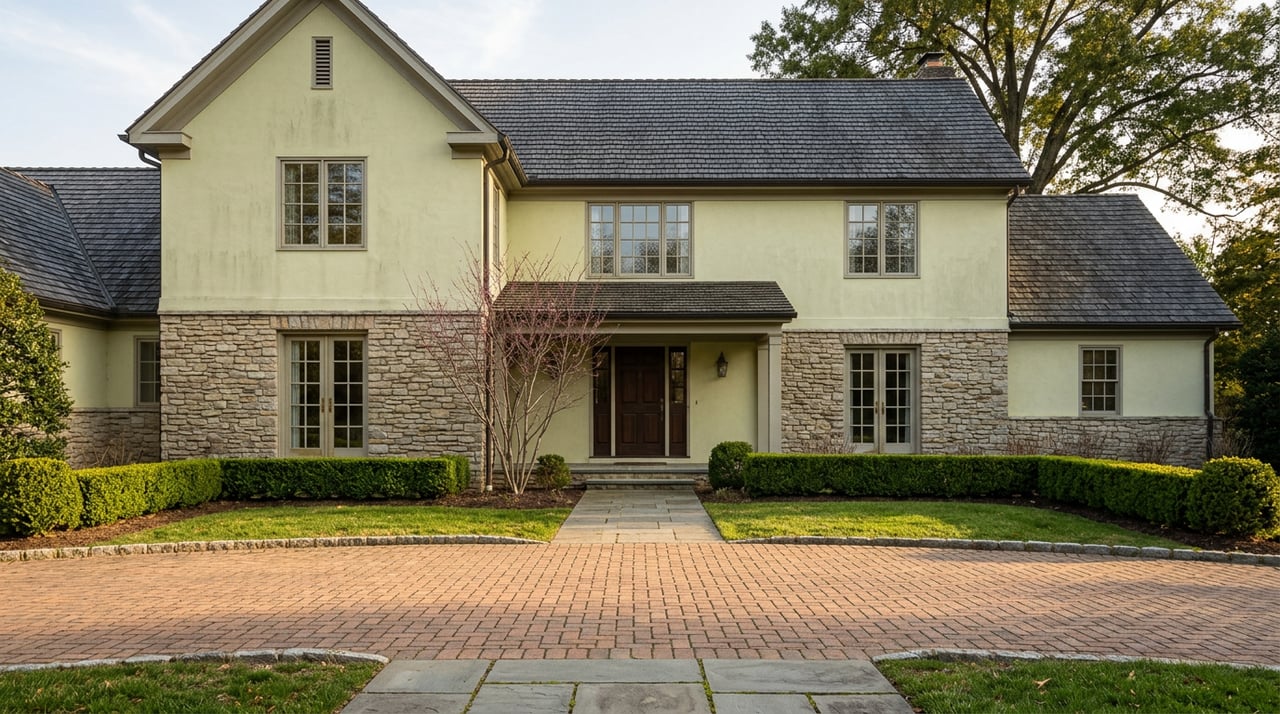
You have probably driven past the entrance to Crockett Park a hundred times without looking left. Everyone looks right, toward the ballfields, because that's where the noise is. Soccer practice on six fields at once. A softball game running long. Kids cutting across the grass toward the playground while a parent yells about cleats. The house sitting quietly near the entrance, white clapboard and a wraparound porch, reads like landscaping. It is not landscaping. It is a building that Brentwood physically saved from a bulldozer by cutting it in half.
That's the piece of Crockett Park that doesn't show up on the scoreboard or the summer concert flyer. The park isn't just Brentwood's second-largest, a roughly 164-acre spread of fields, courts, and trails that most residents treat as one continuous backdrop. It's also where the city has been quietly relocating pieces of its own history for more than thirty years, because the alternative was watching them get paved over. Once you know that, the park stops being a backdrop for practice and starts looking like an archive with a disc golf course running through it.
The House That Left in Two Pieces
The Cool Springs House started life in the 1830s on the west side of what's now I-65, in the path of what would eventually become the Cool Springs commercial corridor. By the 1980s, that stretch of Brentwood was headed toward mall parking lots and office parks, not preservation. The house had actually been added to the National Register of Historic Places in 1983. That designation is usually the end of the conversation. Here it wasn't enough, because the land itself was going to be developed regardless of what stood on it.
So in 1993, the city moved the house instead of losing it. Not a delicate crane lift. The structure was split in half and carried through Brentwood's streets by local fire trucks, with utility crews pulling down poles ahead of the convoy so the halves could fit. Train traffic stopped. Road traffic stopped. Residents along the route had their mailboxes removed for the day. Both halves took a full day each to move. Once the house was reassembled at Crockett Park, its original National Register listing was withdrawn later that same year, because the property was no longer on its historic site. The building survived. The paperwork didn't.
Today the Cool Springs House functions as an event space the city rents out for lunches, meetings, and multi-day wedding bookings. Most people who reserve it are thinking about table layout and parking, not about the fact that the building they're standing in once required a coordinated shutdown of a Brentwood street to arrive there.
A Cabin That Got a Second Life as a Different Building
The house wasn't the only structure the city relocated to Crockett Park that year. The Brentvale Log Cabin has a longer and stranger path to the same address. It was built around 1830 on Old Smyrna Road, the home of William Temple Sneed, son of James Sneed, one of the earliest settlers in what became Brentwood after relocating from Virginia in the 1790s. In the 1930s the cabin was enlarged by joining two separate log structures together. In 1993, the same year the Cool Springs House made its trip, the cabin's owners gifted it to the city, which moved and reassembled it at the park entrance.
The cabin stood there for almost thirty years. Then in July 2022, the city removed it after the foundation had deteriorated past the point of safe repair. That could have been the end of the story. Instead, the timbers, some of them estimated at nearly 200 years old, were preserved and rebuilt into what's now called the BrentVale Pavilion, a structure that still occupies roughly the same footprint at the park entrance. The cabin itself is gone. The wood that made it is still standing in the same place, just wearing a different shape.
Put those two stories next to each other and a pattern shows up that isn't visible from either one alone. Crockett Park isn't a park that happens to have some old buildings in it. It's the place Brentwood decided to send the things it couldn't bring itself to demolish, twice, thirty years apart, using two completely different methods, a house cut in half and driven through the streets, a cabin dismantled and rebuilt as lumber in a new frame.
The Name on the Amphitheater Isn't Random Either
The same instinct shows up in something residents see every summer without asking about it. The amphitheater where Brentwood holds its free concert series and its Fourth of July fireworks is named for Eddy Arnold, the country music legend who spent much of his life as a Brentwood resident. It would have been easy to give the venue a generic name tied to a donor or a committee. Instead the city named its main gathering space after someone who actually lived down the road, which is a small decision that fits the larger habit of keeping local history attached to the places people use every day, rather than letting it fade into a plaque nobody reads.
What This Means for a Walk in September
The concert series wraps every year before the Fourth of July, which means by September the amphitheater lawn is quiet and the crowds that fill it on a summer Sunday evening aren't there. That's actually the better time to notice the rest of the park. The disc golf course starts near the indoor soccer complex on the west side and winds through the wooded section, carpeted tee pads and all, and gets almost no foot traffic outside of the handful of regulars who play it year-round. The paved Crockett Park Loop, close to two miles, connects into Brentwood's broader greenway system, which links this park to Smith Park, the Brentwood YMCA, and the Brentwood Library without requiring a car or a road crossing. If you've lived in Brentwood for years and only ever parked at the ballfields, the loop is worth walking end to end once, specifically because it passes both relocated structures from a different angle than the one you get pulling into the main lot.
None of this changes what Crockett Park is for on a Tuesday evening with a soccer bag in the trunk. It's still the park where your kid has practice and where the tennis courts fill up on weekends. But it's also the closest thing Brentwood has to a public record of what the city was willing to fight for during its fastest growth years, written not in a document but in a house that arrived in two pieces and a cabin that now exists as someone else's building. That's a different kind of neighborhood fact than a restaurant opening or a new coffee shop, the kind you only pick up by living somewhere long enough to wonder why the old house near the entrance never seemed to match anything else in the park.
If walking that history has you thinking about what it would mean to actually live near Crockett Park, or you're weighing a move within Brentwood and want someone who knows which streets feed the greenway and which don't, The Wood Team spends a lot of time in this part of Williamson County and is glad to talk through it. Schedule your free consultation whenever you're ready.